
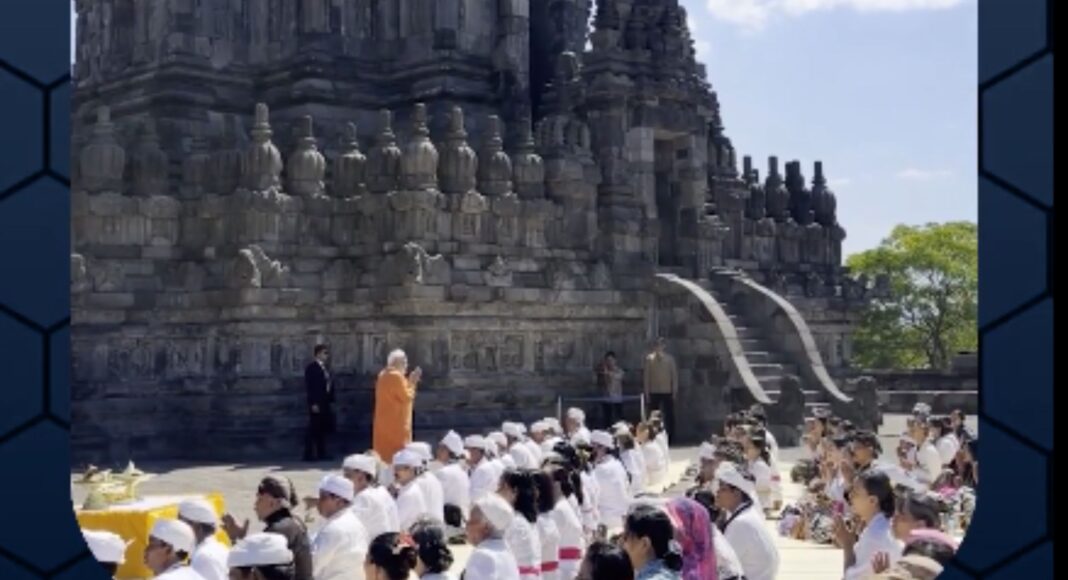
Prime Minister Narendra Modi’s visit to the Prambanan Temple in Indonesia has drawn global attention, particularly across Southeast Asia and the Islamic world. Many observers have questioned why one of the world’s largest Muslim-majority nations is home to a magnificent centuries-old Hindu temple complex and why it featured prominently during the Indian Prime Minister’s visit. The visit has reignited discussions about the deep historical, cultural, and civilizational links between India and Indonesia that date back more than two millennia.
India and Indonesia have shared close trade, cultural, and spiritual ties for over 2,000 years. The influence of the Ramayana, Mahabharata, Sanskrit, and Hindu-Buddhist traditions can still be seen across Indonesian society. The famous Prambanan Temple complex, adorned with intricate carvings depicting scenes from the Ramayana, and the Buddhist monument of Borobudur stand as enduring symbols of this shared heritage. Sanskrit has significantly influenced the Indonesian language, while symbols such as Garuda, the country’s national emblem, and references to Hindu traditions continue to be an integral part of Indonesia’s cultural identity despite its Muslim-majority population.
During his visit to Indonesia, Prime Minister Modi was warmly received by President Prabowo Subianto and highlighted the centuries-old bond between the two countries. Modi emphasized that India and Indonesia are connected not merely by the sea but by a common civilizational legacy shaped by history, culture, and spirituality. Referring to the Ramayana, Mahabharata, Nalanda, traditional Wayang performances, Borobudur, Prambanan, and Indonesia’s national symbol Garuda, he said these shared traditions continue to strengthen bilateral ties.
On the final day of his visit, Modi and President Prabowo jointly visited the 9th-century Prambanan Temple near Yogyakarta, a UNESCO World Heritage Site. Sharing aerial visuals of the temple complex, Modi described it as a magnificent monument reflecting India’s cultural legacy in Southeast Asia. He offered prayers at the shrines dedicated to Lord Shiva, Lord Vishnu, and Lord Brahma, expressing happiness that worship has continued there for centuries. He noted that wherever Indians travel around the world, traces of India’s cultural heritage can still be found.
Prambanan, located on the island of Java, is Indonesia’s largest Hindu temple complex. Construction began around 850 CE under the Sanjaya dynasty during the reign of Rakai Pikatan and was later completed by his successor. Originally known as Shivagriha, the complex was dedicated primarily to the Hindu Trinity—Brahma, Vishnu, and Shiva. Its towering 47-metre Shiva temple remains the centerpiece of the complex. Spread over nearly 40 hectares, Prambanan originally consisted of around 240 temples, with its walls featuring remarkable stone carvings illustrating stories from the Ramayana. It is regarded as the second-largest Hindu temple complex in Southeast Asia after Cambodia’s Angkor Wat.
The temple’s decline began around the 10th century when the nearby Mount Merapi volcano erupted, covering the complex with volcanic ash and forcing the Mataram kingdom to shift its capital. Over the following centuries, the abandoned site was gradually reclaimed by dense forest. A major earthquake in the 16th century further damaged the structures, and many stones were later removed by local residents for construction purposes. UNESCO designated Prambanan a World Heritage Site in 1991, and despite suffering additional damage during the 2006 Java earthquake, extensive conservation work has helped preserve the monument. Today, Prambanan stands as one of the most significant symbols of the enduring cultural and historical relationship between India and Indonesia.
